
Back
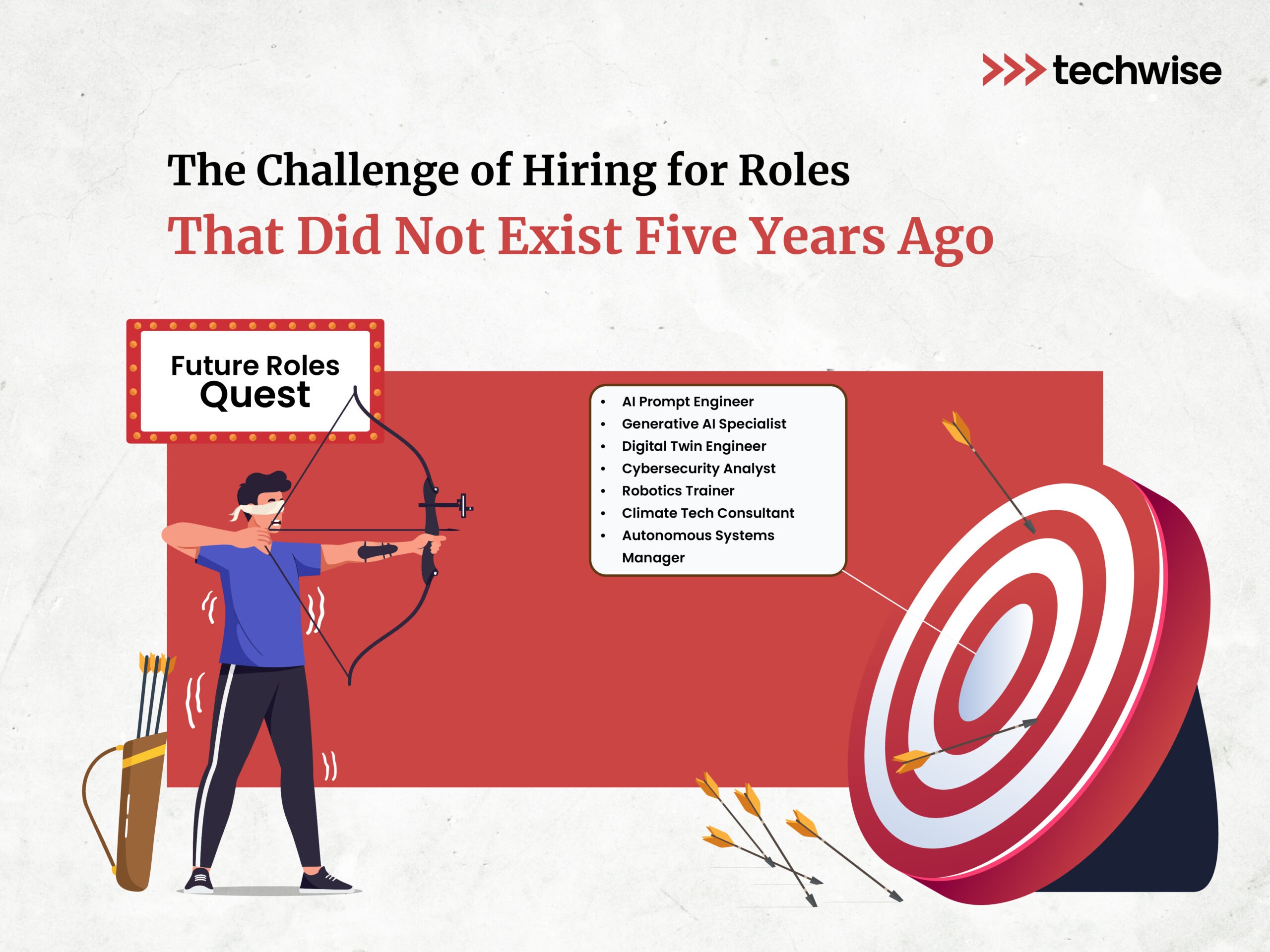
The Challenge of Hiring for Roles That Did Not Exist Five Years Ago
June 23, 2026
Pull up your company’s open roles right now. If you have a Prompt Engineer, Responsible AI Lead, or Quantum Software Architect position – these names would have drawn blank stares at your talent prediction meeting in 2019. Not because the people were uninformed. Simply because the role did not exist.
This is one of the most quietly maddening dilemmas in modern talent acquisition – hiring for roles that the job market did not even know about a few years ago.
The “10 Years of Experience” Paradox
You have seen it. We have all seen it. The job post is asking for a “Senior Generative AI Engineer with 8–10 years of hands-on experience”. The only problem? Generative AI is roughly three to four years old in practice. So, you are essentially finding someone who has been building with tools that were not publicly available when they started their career in this field.
This is a structural flaw in how organisations are calibrating seniority for emergent roles. Hiring managers, under pressure to fill leadership positions, always go to the familiar concept of “years of experience” as an assessment for competence. But for roles born in the last three to five years, that metric simply does not hold up.
The result? You either get candidates who have inflated their timelines, or you watch genuinely exceptional talent walk away because they do not tick a box that never should have been there in the first place.
No Benchmark. No Compass.
Here’s another challenge that does not get talked about nearly enough. What does “great” even look like for these roles?
Traditional hiring has a safety net. When you are hiring a CFO, you have decades of case studies, competency frameworks, and industry benchmarks to lean on. You know what questions to ask.
But when you are hiring a Head of AI Ethics or a Machine Learning Infrastructure Lead for the first time? You are essentially building the benchmark from scratch – while also trying to fill the seat.
Most TA teams are not equipped for this. And it is not their fault. Competency frameworks for new tech roles are either non-existent or written by people who have never actually done the job. Interviewers do not always know enough about the domain to evaluate answers meaningfully, which means hiring decisions quietly drift toward whoever sounds most confident in the room.
The Talent Pool is a Puddle
Think of the talent pipeline for established roles like a river – wide, well-mapped, fed by hundreds of universities, bootcamps, and decades of industry players. Now think of the pipeline for, say, Large Language Model Fine-Tuning Specialists or Quantum Engineers. That is not a river. That is a very small, very competitive puddle.
And everyone is dipping into it at the same time.
The supply-demand mismatch here is severe. Demand for AI-related skills has grown faster than educational infrastructure can respond. Universities are still updating curricula. Certifications are still being invented. And the handful of people who do have real depth in these domains? They are being poached constantly, counteroffered aggressively, and a good portion of them have started their own companies.
So as a TA lead, you are not just competing with industry peers. You are competing with venture-backed startups offering equity, with tech giants offering prestige, and with the candidate’s own entrepreneurial ambitions.
Internal Stakeholders Do Not Know What They Want
This one stings because it is true. Many hiring managers requesting these roles have only a fuzzy idea of what success looks like.
A business leader hears that they need a “Responsible AI Officer”. They have read the headlines, attended a conference, maybe sat through a 40-minute panel. They come to TA with a rough brief – part compliance, part strategy, part communications – and expect you to find someone who checks all those boxes, possibly for a mid-market salary.
The role definition shifts three times during the interview process. The evaluation criteria change after round two. And the final hire is often a compromise candidate that nobody is fully enthusiastic about – because the organisation never really agreed on what they needed in the first place.
This is not a people problem. It is a process problem. And it is one that TA teams increasingly need to solve upstream by facilitating proper role scoping conversations, pushing back on vague briefs, and sometimes educating the very people who issued the hire request.
Compensation is Anyone’s Guess
When it comes to emerging roles, market data barely exists. Due to this, salary benchmarking becomes more of a guesswork rather than industry standards.
For established roles, you can pull data from top job boards and get reasonably solid compensation ranges. For a “Quantum Research Lead”? Only a handful of data will be available. Maybe some limited LinkedIn salary insights that may or may not be accurate.
The danger here is two-fold. Under-pricing the role means losing the best candidates to competitors willing to pay the unknown. Overprice it, and you have set an internal precedent that creates equity issues across your existing team. Neither outcome is comfortable.
And when the candidate you want comes back with a counteroffer that’s 40% above your range – citing three competing offers from companies you have never heard of – you have about 48 hours to either get creative or walk away.
What Can You Actually Do About It?
Now let’s talk strategy. Because only understanding the problem is half the battle, rest depends on how you fight it.
Not Years of Experience, But Depth of Impact
For emerging roles, ask candidates what they have built, broken, and rebuilt. Portfolio evidence, GitHub contributions, papers, projects – these tell a richer story than a timeline.
Build Internal Fluency Before You Hire Externally
TA teams need a working understanding of the roles they are filling. That means learning with your tech leads, reading the same articles the hiring managers are reading, and asking uncomfortable questions like, “Can you explain to me what this person will actually do on a Tuesday?”
Build Talent Intelligence Before Requirements Arise
Map the talent ecosystem for emerging roles six months before you need to hire. Identify key names, institutions, communities, and conferences. By the time the role opens, you should already have warm connections – not cold LinkedIn InMails.
Build Role Scoping into Your Intake Process
Make it non-negotiable. Before a single job description is written, sit down with the hiring manager and define success metrics, must-haves vs. nice-to-haves, and realistic comp ranges. Yes, this adds time upfront. It saves enormous time later.
Think Adjacent, Not Identical
If you cannot find a “Quantum UX Designer,” find someone who deeply understands complex system design and has shown the intellectual agility to enter new domains quickly. Transferable problem-solving often matters more than an exact title match.
The Bigger Picture
The reality is, this challenge is not going away. The pace of technological change means that five years from now, you will be hiring for roles that do not even have names yet. Roles that do not appear in any salary survey, that no university currently prepares people for, and that no recruiter has a script for.
The organisations that will win the talent game are not the ones with the biggest budgets. They are the ones with the most intellectually agile TA teams – people who can hold ambiguity, build frameworks on the fly, and partner with business leaders as genuine strategic advisors rather than order-takers.
So, the next time someone hands you a job description for a role that did not exist three years ago and asks you to fill it in six weeks? Take a breath. And ask questions that matter.