
Back
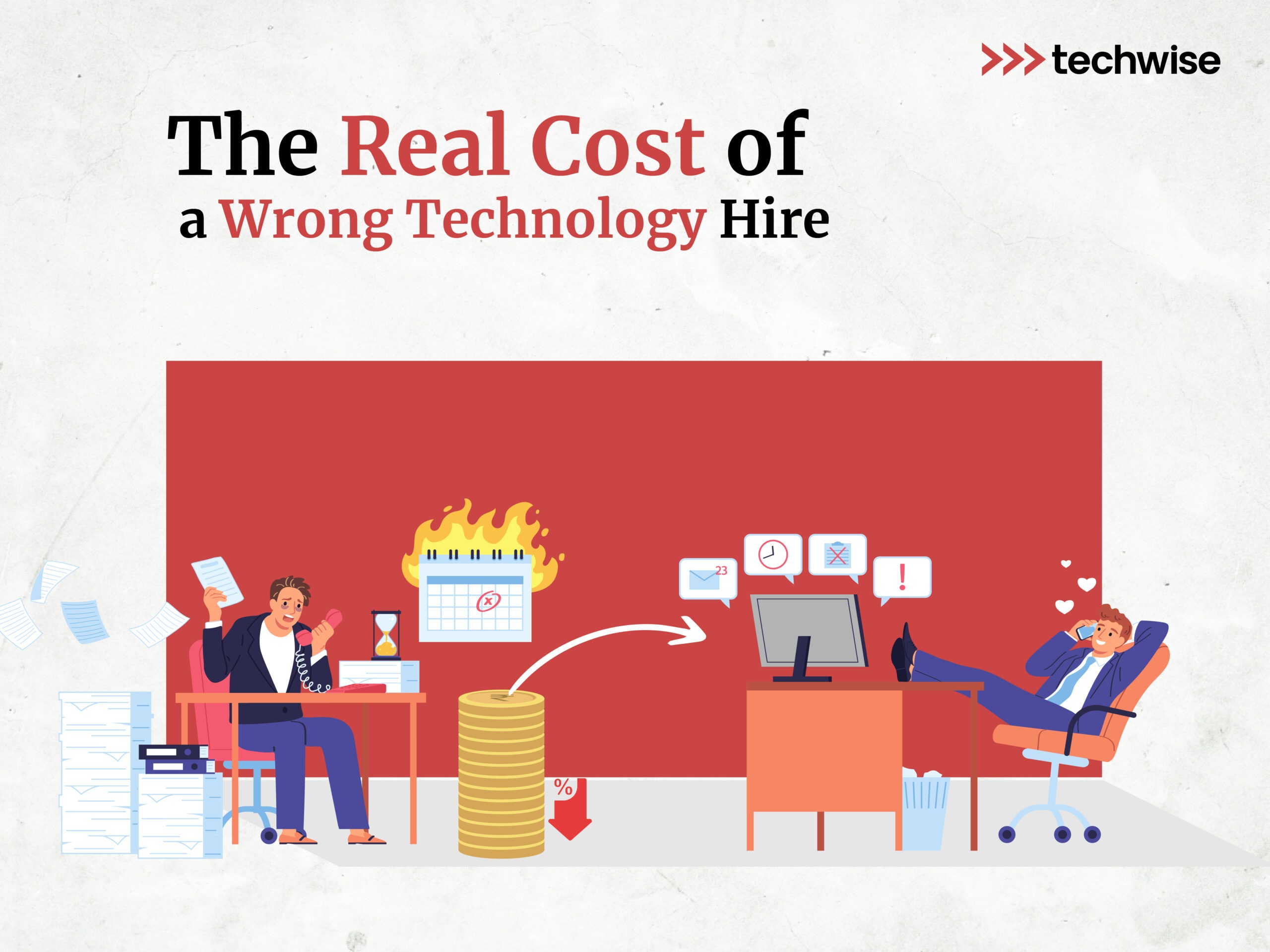
The Real Cost of a Wrong Technology Hire
September 9, 2026
You finally close out a brutal tech search. Eight weeks, four interview rounds, one very persuasive candidate who checked all the boxes, said all the right things. You think you just found the unicorn and decide to hire them.
Four months later, that same desk is empty again. And you are left staring at it, thinking about the project delays, team burnout and wondering: what did this actually cost us?
If your answer is “just their salary”, we need to talk. Because a wrong technology hire is less like a bounced check and more like a slow leak in your basement, you do not notice the real damage until the walls start sagging.
The Number Everyone Quotes
Ask around, and someone will confidently tell you a bad hire costs about 30% of their first-year salary. This figure comes from the U.S. Department of Labor and while it is not actually wrong, it is just the baseline and not the complete picture. Think of it as the “starting price” on a menu that gets very expensive very fast once you start adding sides.
SHRM’s own benchmarking puts the average cost-per-hire somewhere around $4,700 in the United States, while CareerBuilder’s research found the average reported cost of a single bad hire lands closer to $17,000. Additionally, nearly three in four employers admit they have made this mistake at least once. So, you are not uniquely cursed. You are just statistically normal.
Tech Roles Play by Different Rules
Technology hires do not follow the general playbook. They break it. Specialised technical roles routinely push total costs to somewhere between 100% and 200% of annual salary once you factor in lost productivity, project delays, and the rework that inevitably follows.
For a mid-level engineer, that can translate into a huge sum of real organisational damage. Why the markup? Because a mediocre marketing hire slows down one function. A mediocre engineer can slow down everyone downstream of them, the reviewer who has to untangle their code, the product manager whose roadmap just quietly slipped, the on-call engineer fielding 2 a.m. pages because something they shipped is on fire.
Bad tech hires do not just underperform. They generate technical debt ie the software equivalent of financing a car with a payday loan. Someone, somewhere, always has to pay it back, usually with interest.
The Invoice Nobody Sends You
This is where things get sneaky, because most of the real cost never shows up on a single line item. It hides in places like:
- Manager bandwidth. SHRM estimates managers can spend a little under a fifth of their time managing underperformance. The time which could have been used to manage the team’s actual goals.
- Team drag. Gallup’s research ties disengagement to a 14% lower general productivity and an 18% lower sales productivity. One weak link does not just fail to pull weight – it makes everyone else pull more.
- Attrition you did not see coming. Your best engineers have options. When they spend three months quietly cleaning up after a bad hire, some of them start updating their LinkedIn instead of their code comments.
- Time-to-productivity, twice over. New hires already take months to ramp. When that hire fails, you have paid for the ramp, and you are about to pay for another one.
A fast-growing startup brings in a senior engineer with an impressive resume and zero red flags on paper. Within a couple of quarters, two of the team’s strongest performers quietly hand in notice, citing “team dynamics”. Replacing them costs more, in money and disruption, than the original bad hire ever did. That’s the domino effect – and it rarely stops at one tile.
Why This Should Matter Most to You
If you are a TA leader, you already know hiring is a numbers game. But the cost of a wrong hire is not a recruiting problem. It is a business risk that happens to start in recruiting. Every wrong technology hire quietly erodes three things that are brutally expensive to rebuild – trust, velocity, and morale.
So, what actually moves the needle?
- Slow down at the point that matters. Speed-to-hire is great for vanity metrics, terrible for technical vetting. Structured, skills-based interviews consistently outperform “gut feel” and charisma.
- Interview for friction points, not just fluency. A candidate who can explain algorithms but cannot take feedback will cost you more than one who is slightly less polished but genuinely coachable.
- Fix onboarding before you fix sourcing. Companies with weak onboarding are far more likely to lose new hires within the first year, meaning some “bad hires” were never bad at all, just badly set up to succeed.
- Track time-to-productivity like a KPI, not a formality. If you are not measuring it, you are not managing it.
- Build a real off-ramp process. The single biggest hidden cost in most bad-hire stories is not the hire; it is the lag between noticing the problem and acting on it.
The Bottom Line
A wrong technology hire was never just a line on a spreadsheet. It is morale, momentum, and months of work, quietly draining away while everyone is too busy shipping to notice. The good news? It is preventable. Tighten your interview process, invest in onboarding, and shrink that “we know it is not working” gap, and you turn one of your biggest hidden costs into one of your most controllable ones.
So, the next time a tech hire does not work out, will you know exactly what it cost you or just guess? If you are rethinking how your team evaluates technical talent, now is a pretty good time to start.