
Back
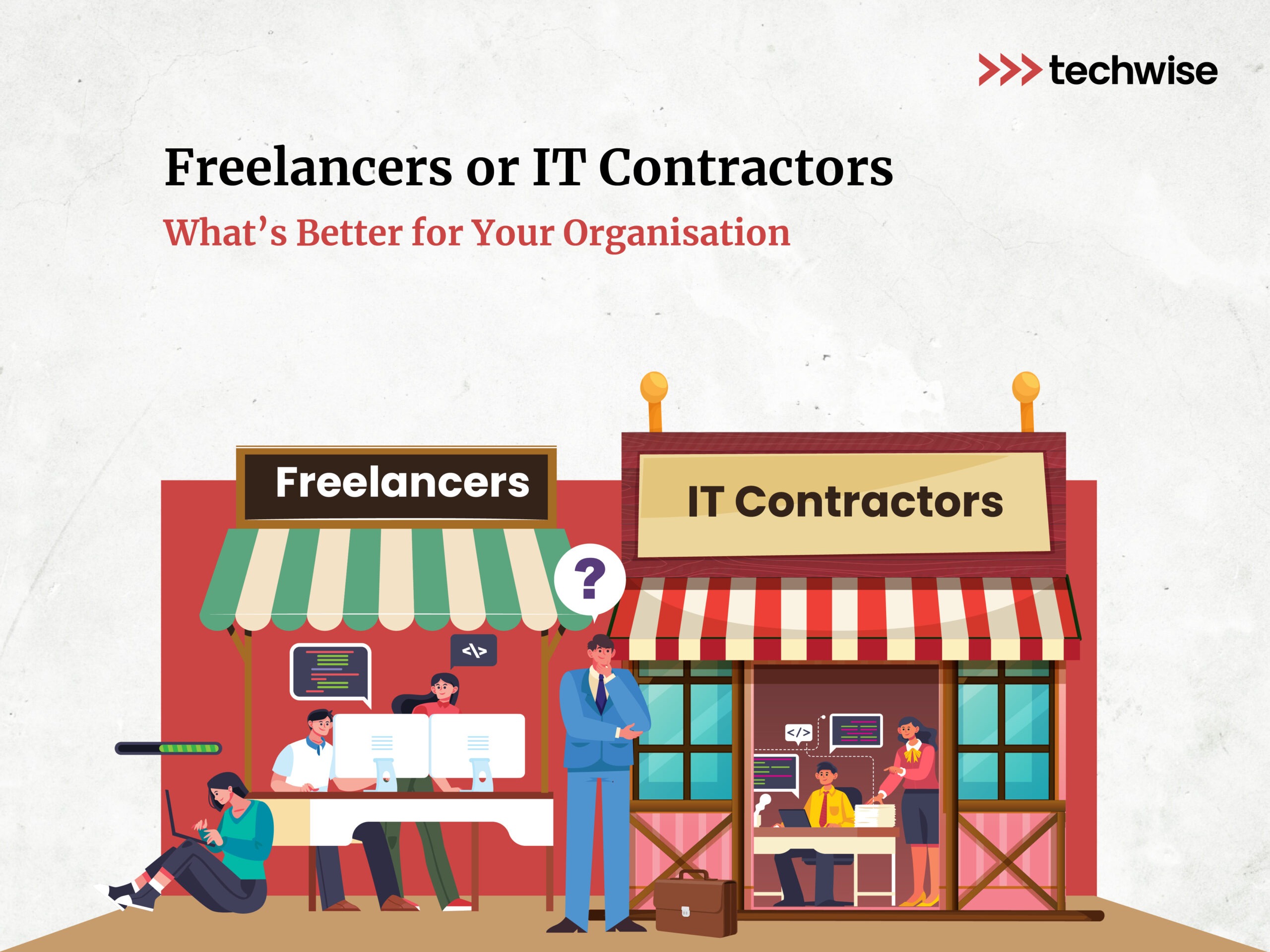
Freelancers or IT Contractors – What’s Better for Your Organisation?
May 27, 2026
The way your organisation staffs IT talent today looks nothing like it did five years ago. The pandemic cracked the traditional employment model wide open, and what emerged was a complex mix of full-timers, contract professionals, and freelancers.
“So, which one should we hire?” If you have asked yourself this in the middle of a resource planning meeting, you are not alone.
Most advice on this topic rehashes the obvious: freelancers are cheap, contractors are reliable, and full-time is commitment. But you already know that. What you need are the nuanced, real-world decision factors that do not make it into listicles.
Let’s break down some overlooked but critical aspects that should actually shape your choice between a freelancer and a contract professional.
Who Owns the Knowledge After the Project Ends?
You hire a brilliant freelancer to build a custom API integration. Three months later, the project is done, the freelancer is off to their next gig, and your internal team is left staring at documentation that might as well be written in ancient languages. Sound familiar?
Knowledge transfer is not a line item for most freelancers – it is an afterthought.
Freelancers operate in sprint mode. They are wired to deliver outputs, not outcomes. Their mental bandwidth is consumed by the deliverable – not by ensuring your team can carry the torch.
Contract professionals, on the other hand, are typically embedded for longer durations and operate within a more structured engagement framework. Most staffing agreements include at least some form of knowledge handoff protocol. More importantly, they develop an institutional understanding of your systems, culture, and quirks that a freelancer cycling in for eight weeks simply cannot replicate.
So, how do you decide?
If your project involves complex, proprietary systems or will require internal maintenance after completion, the knowledge continuity of a contract hire is worth every additional rupee. A freelancer who builds something no one else understands is not a bargain – it is a liability dressed in a discount.
Dependency Chains and Project Derailment
You have got a freelancer who is genuinely exceptional. They are fast, creative, and your project is flying. Then, they land a bigger client. Suddenly, you are third in the priority queue, response times creep from hours to days, and your go-live date starts looking like a suggestion rather than a deadline.
This is the freelancer loyalty gap – and it is not talked about enough. Freelancers are, by design, entrepreneurial. Their income depends on taking multiple engagements simultaneously. Your project is one of several, not THE project.
Contract professionals, especially those placed through reputable staffing firms, carry a layer of accountability that freelancers simply do not. Their engagement terms, SLAs, and even penalties are codified. The staffing firm has skin in the game. That structure changes behaviour.
- If your project is on a critical delivery timeline, contract staffing gives you enforceable commitments.
- If timelines are flexible and exploratory, a skilled freelancer can bring nimble value without the overhead.
- If you are running multiple parallel workstreams, consider that one freelancer stepping back can create a cascade of delays across teams.
A tip before hiring a freelancer: always ask how many active clients they are serving. The answer will tell you everything.
Compliance, IP, and the Legal Minefield
The legal and compliance exposure of hiring a freelancer versus a contractor is dramatically different, and it can cost you enormously if you get it wrong.
Misclassifying a long-term freelancer as an independent contractor – when, in practice, they function like an employee – can trigger a lot of problems. Think tax liabilities, labour law violations, and benefit claims. The UK has IR35. India has its own evolving gig worker regulations. This is not a hypothetical risk; companies have paid millions in settlements over this.
A ₹50,000 freelancer engagement can quietly become a ₹5,00,000 legal problem if the classification is wrong.
Intellectual property is another landmine. With a freelancer, if your contract is not airtight, there is ambiguity around who owns the code, the design, or the data model they built. With a formal staffing contract, IP assignment clauses are standard.
So, if your project involves proprietary technology, sensitive customer data, or will produce assets that form the backbone of your product, go with contract staffing. The legal scaffolding alone is worth it. Freelancers are fine for peripheral work where IP risk is low.
The Cultural Integration
How much does it matter that the person working on your project actually gets your organisation?
For a two-week UX audit? Probably not that much. For a six-month cloud migration that requires daily stand-ups with your DevOps team, executive stakeholder reviews, and cross-functional collaboration? It matters enormously.
Freelancers are, professionally speaking, guests. They arrive with their laptop, do the job, and leave. There is rarely an investment in cultural fit or team cohesion. And that is fine for discrete, contained projects.
Contract professionals who are placed for three months or longer tend to go through at least a soft onboarding. They attend team meetings, absorb the communication norms, and develop working relationships. Research consistently shows that embedded contributors deliver higher-quality work on complex projects simply because they understand context.
There is also the morale angle. Your permanent employees notice how temporary talent is treated and integrated. A revolving door of disconnected freelancers can erode team culture subtly but meaningfully over time.
- Short, contained, output-specific project? Freelancer wins on speed and simplicity.
- Extended engagement requiring collaboration? The cultural lift of a contract professional pays dividends.
- Sensitive team dynamics at play? Be very deliberate. The wrong freelancer in a delicate environment can do more harm than good.
The Final Verdict
Choosing between a freelancer and a contractual employee does not depend on a single aspect.
The strongest organisations treat talent as a portfolio: freelancers for agile, peripheral tasks; contract professionals for mission-critical, collaborative, IP-sensitive projects. The key is strategically matching talent type to project need.
As the IT talent market continues to evolve, the organisations that win will not be the ones with the lowest average cost-per-hire. They will be the ones who consistently match talent type to project need with surgical precision.
So next time someone in your planning meeting asks, “Should we freelance this or contract it?” – you will know exactly where to start the conversation.