
Back
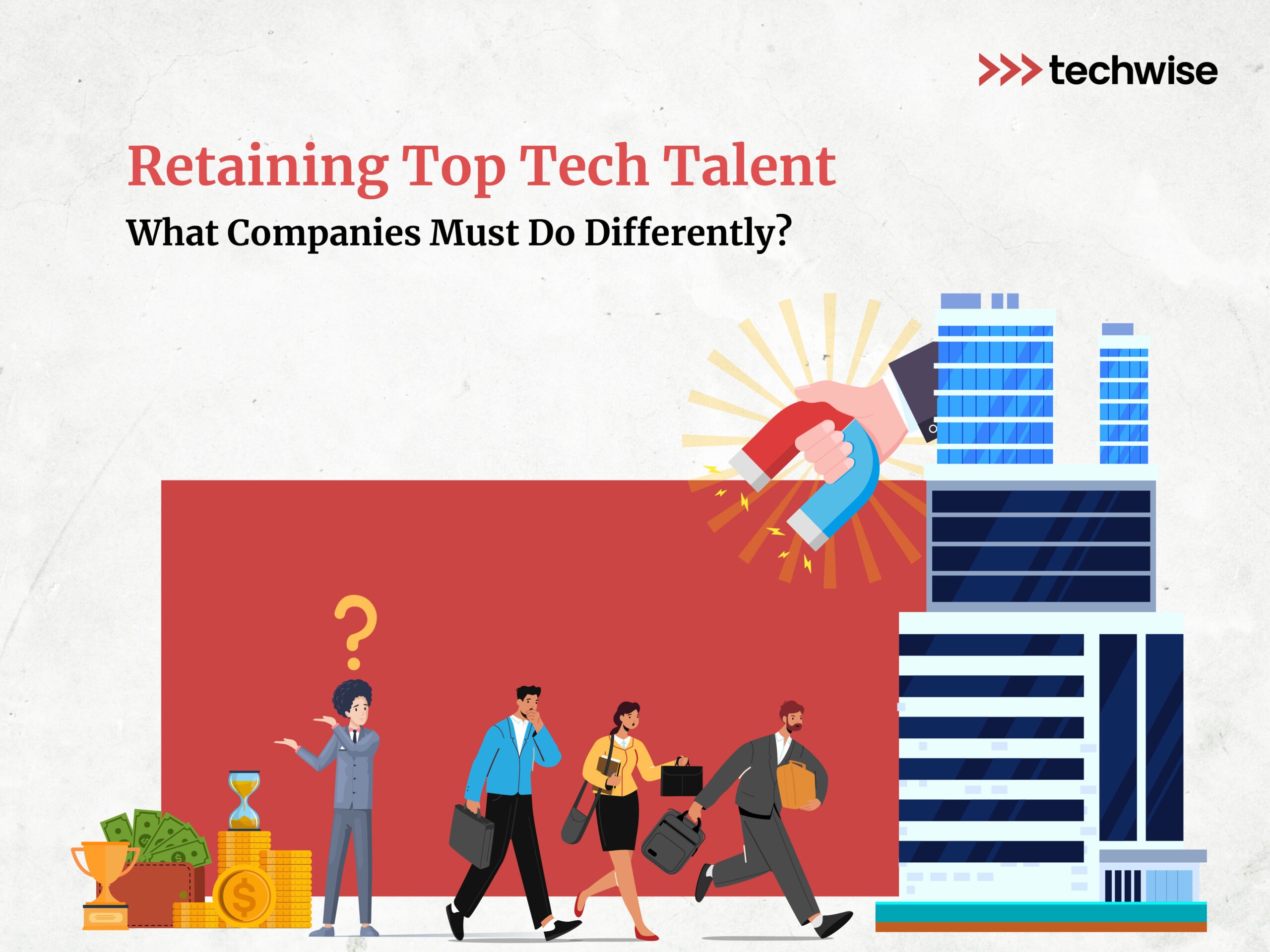
Retaining Top Tech Talent: What Companies Must Do Differently?
June 10, 2026
It takes a lot of hunting and great effort for a hiring team to finally close a difficult position. But then, a sudden resignation turns the tables, and the recruiter goes back to the starting point yet again.
Retaining top talent today, fancy compensations and designations are not enough. Companies now have to compete on much more. While earlier, job-hopping was merely a trend, for tech talent these days, relevance, relevance, advancement, and experience hold more credibility.
So, what’s really behind the gap between hiring great talent and keeping them around?
The Niche Tech Retention Crisis
Tech talent today is not bound by location or tradition. They can work from anywhere, explore every opening in real time, and switch jobs without second-guessing themselves. For them, moving is not disloyalty, but a way to level up. The moment a role stops teaching them something new, they’re gone.
Companies are not just losing people to competitors, but they are losing them because they may not be keeping up with the pace of how work, growth, and careers have changed.
The Real Reasons Your Best Talent Leaves
Compensation is no longer the only reason people decide to leave. So, what’s really driving tech talent away?
In reality, top tech talent leaves when:
- Their ideas are heard, but never acted on: Being asked for input without seeing follow-through feels performative. Over time, that becomes draining for ambitious talent.
- Too much fixing, not enough building: When every week feels like damage control, the job starts feeling like survival. Top talent wants to build, not just patch.
- The company’s pace and the employee’s ambition stop matching: Some talent wants to experiment and evolve faster than the company allows. That mismatch becomes a quiet reason to leave.
- Growth feels slower than the industry: When employees feel there is not much left to learn, they start hunting for something else.
- Work becomes repetitive: Monotonous work can disengage high-performing professionals. Challenges can make a huge difference.
- Flexibility is controlled, not trusted: Remote work policies that feel restrictive often push people away quietly.
Here’s the irony – companies invest heavily in hiring top talent, but often underinvest in keeping them engaged once they’re in.
What Companies Must Do Differently
Understanding ‘why talent leaves’ is only half the equation. The real question is ‘what are companies doing about it?’ The following are the pre-requisites:
Clarify Vision and Purpose First
Before asking talent to commit, the foremost step for companies must be to clarify their own vision.
Top tech talent and potential performers want to understand where the organization is heading and how their work contributes to it. Without clarity, even the best benefits and flexible policies can feel hollow.
When employees see a clear purpose, they are far more likely to stay invested in their role and the company itself.
Make Learning a Continuous Experience
In tech, relevance has a short shelf life.
Companies that embed learning into everyday work through projects, mentorship, and real-world problem solving naturally retain curious minds. Because when people grow, they stay.
Design Careers, Not Just Roles
Traditional career paths feel linear in a world that isn’t.
Employees today want fluidity and the ability to explore adjacent skills, shift across teams, and evolve without changing companies.
Think less about promotions and more about possibilities.
Rethink Flexibility and Trust
Remote work opened the door. But how organizations manage it defines whether people stay.
Flexibility is not just about location, it’s about autonomy. Trusting employees to manage their time, their output, and their work style creates a sense of ownership that policies alone cannot.
Move Beyond Compensation as the Main Lever
Yes, compensation matters. But it is no longer the differentiator; it is the bare minimum.
The top tech talent is not just asking, “What am I earning?” They’re asking, “What am I becoming?”
Organizations that focus only on pay will always be outbid by someone else. Those who focus on growth, however, build something harder to replace.
Why Retention Is a Business Priority
Replacing talent may seem like a quick fix, but in tech, it rarely is.
When someone leaves, the organization loses context, pace, and hard-earned knowledge, and finding a close match often takes far longer than expected.
Here are the key reasons why retention takes priority:
- Finding the right replacement takes time, especially for specialized roles.
- Knowledge transfer is never instant, slowing down onboarding and processes.
- Business momentum gets disrupted while the new person adapts.
- Client trust can be affected when continuity is interrupted.
- Retention protects institutional knowledge that resumes can’t replace.
In a fast-moving industry, retention is not just about stability; it is about protecting speed and performance.
The Core of Retention
Retention is not really a challenge, but an art that top tech companies are mastering. They do not hold onto people, but they make them want to stay.
While retaining top tech talent feels complex, it is actually simpler than it looks.
People stay where they feel their growth matters, their work has purpose, and their voice is heard. They stay where the company invests in them as much as they invest in it.
The shift is not about fixing problems when people leave. It’s about building an environment where staying makes sense from the start.
Because in the end, retention is not about keeping people from walking out the door. It is about creating a place where they can leave an impact, and they do not want to walk away from.