
Back
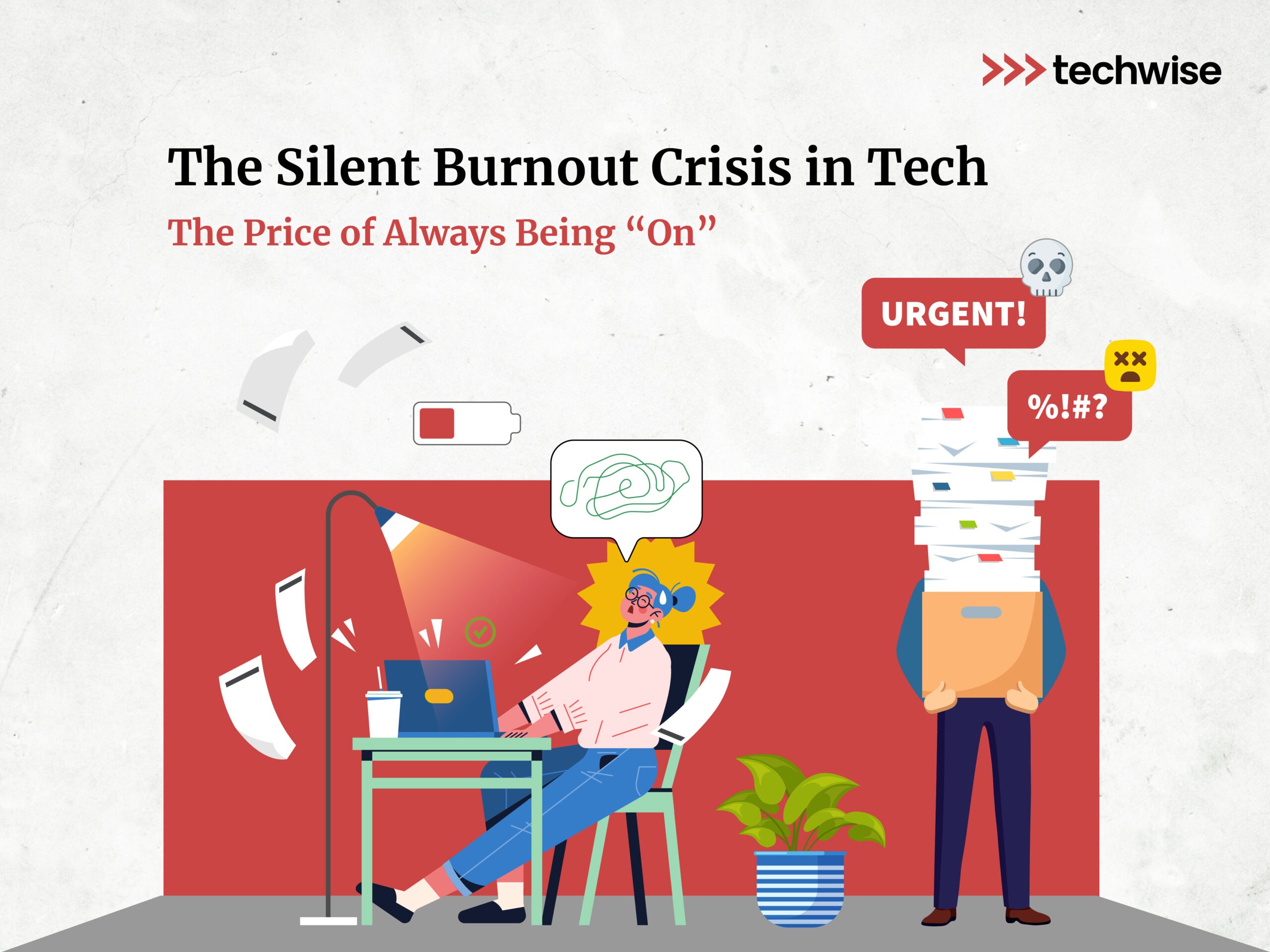
The Silent Burnout Crisis in Tech: The Price of Always Being “On”
May 13, 2026
A backend engineer wraps up a late-night production fix at 2:30 AM. By 9 AM, they’re back on a stand-up call, camera on, but energy off. And the same cycle keeps continuing. Deadlines don’t move. Neither does the expectation to stay “available” almost all the time.
While everything may look fine and productive from the outside, inside, it is a slow system failure.
And this is exactly what burnout in tech looks like today. It is not at all the dramatic exits and cries for help. But it is the quiet disengagement hiding behind green status dots and polite flabby replies.
Burnout in Today’s Tech Workforce
Burnout in tech is not just about long working hours. It is about sustained mental load without meaningful recovery. The kind where your brain never fully switches off.
In modern IT environments, especially when it comes to contract roles, remote teams, and global delivery cycles, work has no clear boundary. There’s always something pending, and someone waiting.
Over time, this shows up in subtle but critical ways:
- Strong performers are becoming risk-prone
- Problem-solvers who fall back on standard functioning
- Decrease in engagement without an obvious issue
For hiring leaders, this is where the real risk begins because the decline is gradual, not dramatic.
Where the Pressure Is Really Coming From?
The current tech ecosystem is optimized for speed, but is it really doing its bit for sustainability?
There are instances where Global delivery models stretch work across time zones, often extending the workday without formally acknowledging the time difference. Contract professionals, in particular, work under constant visibility pressure. In the midst of all this, performance is not just about output but also about responsiveness.
Then comes AI acceleration. Work is faster, but expectations are faster still. What was once a full sprint is now anticipated in the middle of the week. Teams have minimal flexibility when tight hiring techniques are added. Since everyone is necessary, nobody can truly take a step back.
At some point, “being available” quietly became more important than being effective and productive.
The Business Cost of an Exhausted Workforce
Burnout doesn’t immediately break teams. It gradually weakens them.
You will notice it when great hires start underperforming within months, even though nothing has changed. According to recruiters, candidates start to hesitate more about flexibility and workload than they do about pay.
Within organizations, the impact spreads wider than expected. Innovation slows down because people don’t have the energy to think beyond execution when the number of work hours matters more than creativity and completed deadlines. Teams deliver, but rarely improve.
The Problem Nobody Wants to Deal With
Here’s the contradiction – burnout often exists alongside high output.
When deadlines are met, clients are satisfied, and metrics look healthy, teams running at full capacity may look like top performers on paper. But underneath that performance:
- Knowledge dwells in a small number of worn-out people.
- Team morale declines in ways that aren’t apparent right away
- Employee departure risk gradually increases until it suddenly rises.
Early Signs Most Teams Miss
Burnout is not something that comes with a loud announcement. There are patterns that need to be observed and worked upon.
A creative employee who always has numerous points during a meeting suddenly becomes quiet. People start focusing only on the work that has been assigned to them. Small errors creep into the daily work routine. You might also notice a drop in curiosity. Fewer questions, fewer ideas, and less to no initiative.
Here are some other common early signals that are easy to miss, especially in large teams:
- Reduced participation in discussions
- Minimal engagement beyond assigned tasks
- Increased dependency on instructions
- Subtle decline in the quality of work
Running High-Pressure Teams Sustainably
The smart way that many effective organizations are following is not to eliminate the pressure entirely, but to design work models for sustainability. They’re redefining productivity by focusing on the end product instead of constant and quick responses.
In contract staffing, smarter engagement models are coming through effectively:
- Clearly defined work hours and communication boundaries
- Realistic workload expectations from the start
- Regular check-ins that go beyond task updates
Managers, too, are being trained to identify early signs of burnout and adjust before it escalates.
Beyond Speed: The Future of Tech Work
With the rapid evolution taking place in the tech industry, speed alone is no longer a sustainable advantage. The real differentiator is how long a team can perform at a high level without breaking down.
Burnout is no longer just a people issue. It’s a signal that the system itself needs redesigning.
Rethinking the “Always On” Culture
The tech industry does not have a talent shortage. The only problem lying there is the lack of sustainability. If your teams are constantly active but gradually disengaging, you must realize that the burnout is in process, killing productivity.
The key change for hiring managers is to start building for longevity rather than just speed. Because in a market where talent has options, the companies that ignore burnout would not only lose performance, but also people who could have stayed.