
Back
Why Internal Hiring Teams Are Overwhelmed in High-Growth Tech Companies
October 20, 2026
Your company is on fire – the good kind. New clients are signing every week, and leadership just greenlit twelve new headcounts across engineering and delivery. Exciting, right?
Now walk over to your recruitment team’s desk. What do you see?
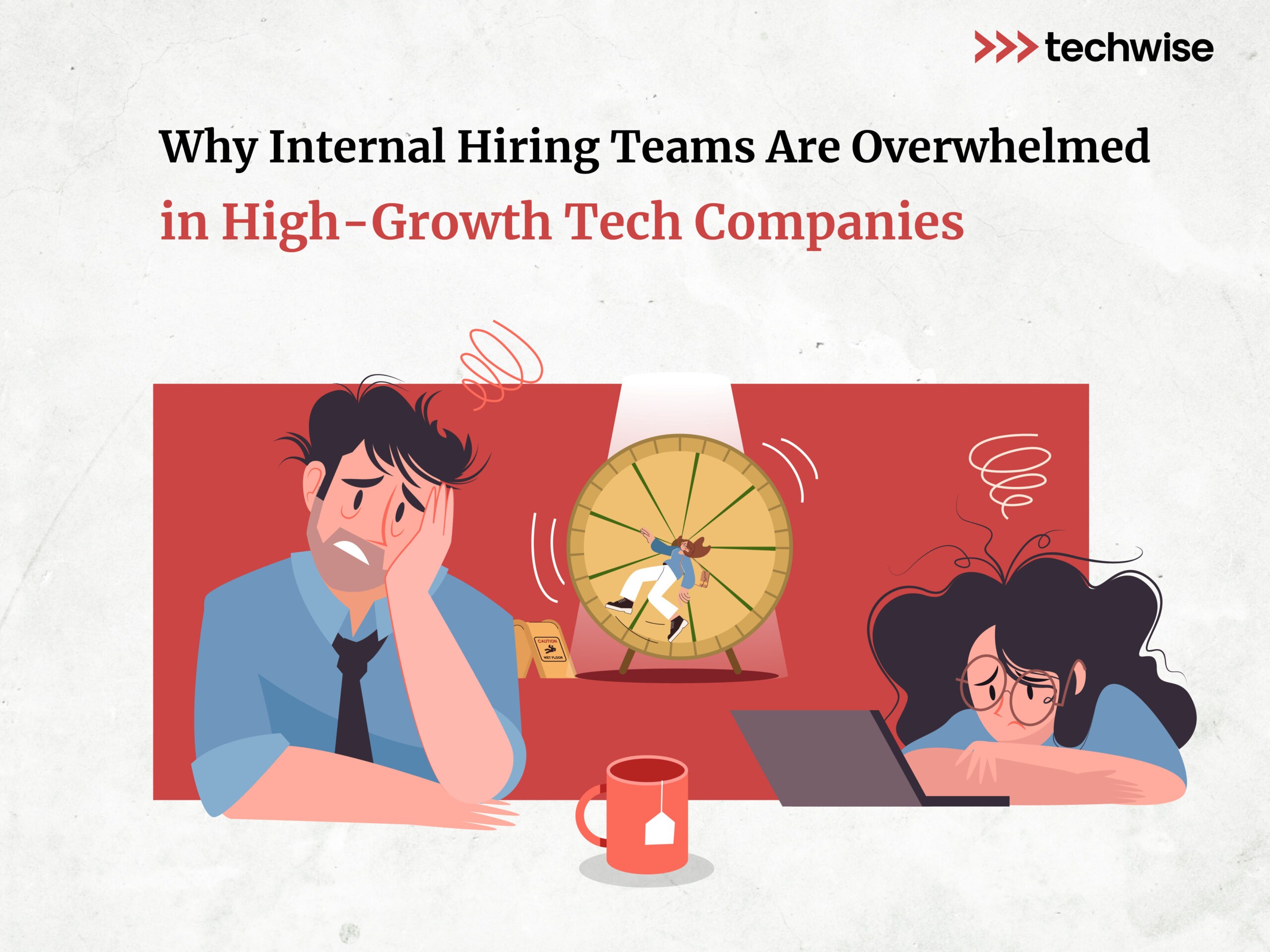
A recruiter with fourteen browser tabs open, an MS Teams channel screaming with hiring manager pings, and an ATS groaning under nine hundred unopened applications for a single senior backend role.
That’s not a hiring team. That’s a small, well-dressed fire.
And the truth is, this is not bad luck. It is bad planning that finally caught up.
The Real Reasons Your TA Team is Crumbling
Let’s break down and dig deeper into why your internal hiring teams are struggling.
1. You Hired for Today’s Problem, Not Tomorrow’s
Most high-growth tech companies treat hiring as a reactive function – a request comes in, a job gets posted, and only then does anyone think about capacity. But growth does not announce itself a week in advance.
It shows up in the sales pipeline months before it shows up in your ATS. If TA is not sitting in on revenue forecasting conversations, they are always going to be sprinting to catch up with a headcount plan nobody told them was coming.
2. The Application Avalanche Has No Filter
Post a mid-level developer role today, and you will likely get hundreds of applications by tomorrow EOD – most of them not remotely qualified. Somewhere in that pile is your next great hire, buried under two hundred resumes from people who applied because the “Easy Apply” button was easy.
Without smart sourcing, pre-screening automation, or sharper job descriptions, your recruiters end up trying to find a needle in a haystack.
3. Recruiters are Outnumbered, Not Under Skilled
In hyper-growth mode, a recruiter-to-requisition ratio can quickly reach up to 40, 50, sometimes more. Ask yourself, can a human keep up with that kind of pressure? And sadly, nobody adjusted the ratio – the roles just kept coming.
Add in slow hiring-manager feedback, interview scheduling back and forth, and the fact that recruiters are often expected to be sourcers, coordinators, and candidate-experience champions all at once – and burnout is not a risk anymore. It is certain.
So no, your hiring team is not overwhelmed because they are bad at their jobs. They are overwhelmed because the system around them was never built for this volume.
“Hire More Recruiters” is Not the Fix
Hiring more recruiters is not the right thing here. It never was because as soon as the positions start filling up, recruiters will not have enough to do. That’s not proper workforce planning.
1. Build Workforce Planning into Your Growth Strategy
If sales is forecasting three new enterprise accounts next month, TA should already know what that means in headcount terms.
Tie hiring plans to revenue and delivery forecasts, not to the moment a hiring manager finally files a request. This alone eliminates most of the firefighting.
2. Tighten the Top of the Funnel
Sharper job descriptions, structured screening questions, and AI-assisted resume filtering are small hacks that can give your hiring teams the breathing room they need.
The goal is not fewer applicants – it is fewer irrelevant ones clogging the pipe.
3. Spread the Load across the Business, Not Just TA
Hiring managers need skin in the game too – structured interview panels, agreed-upon scorecards, and 48-hour feedback SLAs.
A recruiter chasing a hiring manager for a week over one interview feedback should not be a problem you are facing during a growth period.
4. Partner with a Contractual Tech Staffing Company
This is the one most companies discover too late. When your internal team is buried, and permanent hiring is going to take 60–90 days you do not have, contractual tech staffing partners let you plug in vetted, ready-to-deploy talent in days, not months.
You get the skill and delivery capacity your clients need right now, without the multi-month hiring cycle, the payroll overhead, or the long-term commitment of a permanent seat.
Need a team of three developers for a six-month client engagement? A staffing partner hands you that bench without your internal TA team touching a single resume. It is just a smarter operating model for scaling delivery while your permanent hiring engine catches its breath.
Companies that lean on this early avoid the exact meltdown we just described.
5. Automate the Friction, Not the Relationship
Self-scheduling tools, automated status updates, and chatbot-driven FAQs handle the repetitive admin that eats a recruiter’s day.
That frees up actual humans to do the part that still requires a human – building relationships with candidates and closing your best people before a competitor does.
The Bottom Line
An overwhelmed hiring team is not a staffing problem you solve by hiring more recruiters and hoping for the best. It is a planning problem, a process problem, and a “why did we not bring in outside help sooner” problem.
The companies that scale smoothly are not the ones with the biggest TA teams. They are the ones who saw the wave coming and built a system ie internal planning plus external staffing partnerships; flexible enough to ride it.
So, before your next growth spurt turns your recruitment team into a burnt-out fire brigade: are you planning your hiring, or just reacting to it?